Go or Node.js for your mobile app's backend in 2026
Both Go and Node.js can run a solid backend for a mobile app. Here's how I'd choose between them based on the work your API actually does, not benchmarks.

4 min read
Every mobile app eventually needs a backend: an API for login, data sync, payments, notifications. And sooner or later, someone asks: should we build it in Go or Node.js?
You'll find plenty of benchmarks online claiming one is several times faster than the other. Most of them test a "hello world" endpoint that looks nothing like a real app, so I don't put much weight on them.
Here's how I'd actually make the choice.
Start with what your API spends its time doing
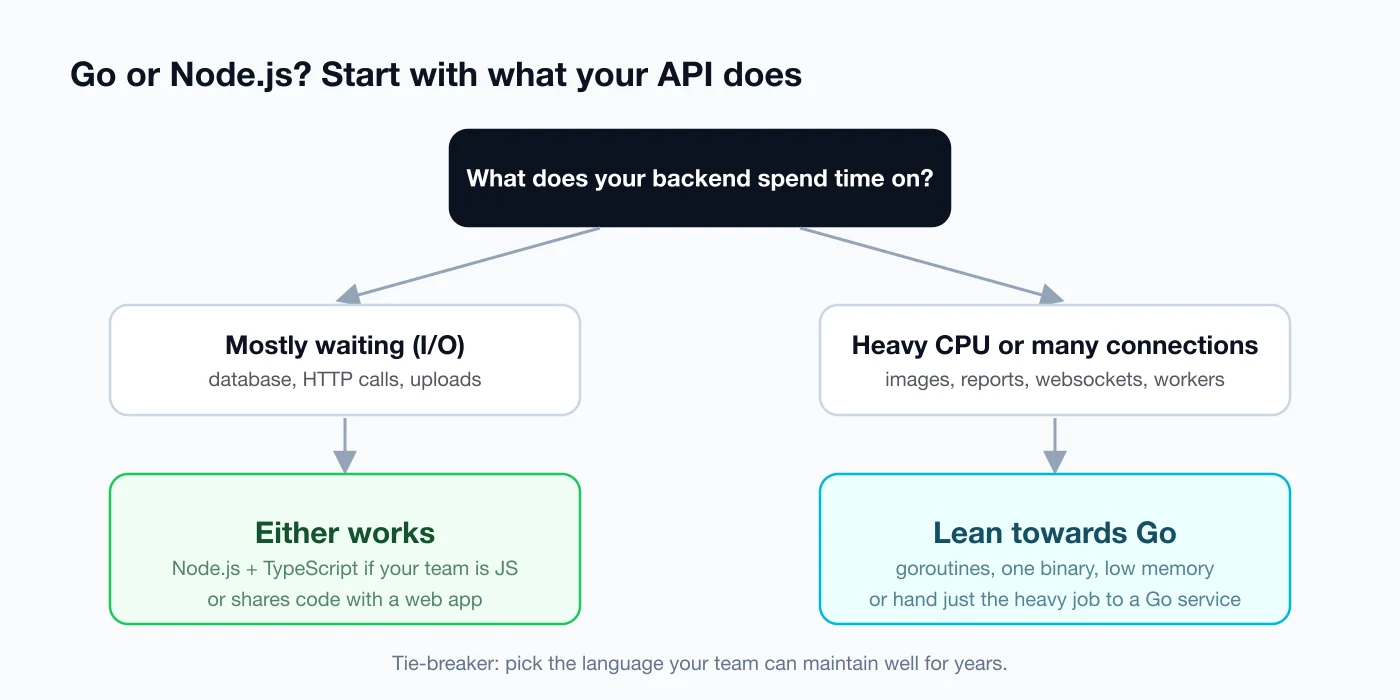
Most mobile backends spend their time waiting: on the database, on another HTTP service, on a file upload. That's I/O-bound work, and both Go and Node.js handle it well. Node uses an event loop; Go uses lightweight goroutines. For a typical REST API in front of a database, the difference in speed is rarely what decides whether your app feels fast.
The difference shows up when your backend does real CPU work: resizing images, generating PDFs, crunching reports, heavy encryption. Node.js runs your JavaScript on a single main thread, so one CPU-heavy request can slow down everyone else unless you move it to worker threads. Go spreads goroutines across all CPU cores by default.
Where Node.js shines
- One language, front to back. If your web dashboard is in React or Next.js, a TypeScript backend lets you share types and validation between them.
- The npm ecosystem. Whatever you need — payments, auth, email, PDF — there's a mature package.
- Speed of building. For an MVP, it's hard to beat how quickly you can go from idea to working endpoint.
A small endpoint in Node with Express looks like this:
import express from "express";

const app = express();

app.get("/posts/:id", async (req, res) => {
  const post = await db.findPost(req.params.id);
  if (!post) return res.status(404).json({ error: "Not found" });
  res.json(post);
});

app.listen(3000);Where Go shines
- One small binary.
go buildproduces a single executable. Nonode_modules, no runtime to install — just copy it into a minimal container and run it. - Concurrency without ceremony. Goroutines and channels make it natural to handle lots of simultaneous connections — websockets, streaming, background jobs.
- A strong standard library. Since Go 1.22, the built-in router supports HTTP methods and path parameters, so many APIs don't need a framework at all.
- Container-friendly by default. Since Go 1.25, the runtime respects a container's CPU limit when choosing how many threads to use, which avoids a classic source of throttling on Kubernetes.
The same endpoint in Go, using only the standard library:
package main

import (
	"encoding/json"
	"net/http"
)

func main() {
	mux := http.NewServeMux()

	mux.HandleFunc("GET /posts/{id}", func(w http.ResponseWriter, r *http.Request) {
		post, err := db.FindPost(r.PathValue("id"))
		if err != nil {
			http.Error(w, "not found", http.StatusNotFound)
			return
		}
		w.Header().Set("Content-Type", "application/json")
		json.NewEncoder(w).Encode(post)
	})

	http.ListenAndServe(":3000", mux)
}
It's a little more typing, but there are zero dependencies, and the compiler catches a whole class of mistakes before you deploy.
How I'd decide
Pick Node.js (with TypeScript) if:
- Your team already writes JavaScript or TypeScript
- You're sharing code with a web front end
- You need to ship an MVP fast
- Your API mostly reads and writes a database
Pick Go if:
- Your backend does CPU-heavy work, or holds many long-lived connections
- You want small, simple deployments and low memory use
- The service will run for years and be maintained by different people — Go's simplicity really pays off here
- You're building infrastructure: workers, queues, proxies, CLIs
And remember: it doesn't have to be all-or-nothing. A common pattern is a Node.js API for the app, with one Go service for the heavy job — image processing, for example — that Node hands work to.
My own experience
I've built APIs with Node.js and TypeScript, including the backend for a point-of-sale system, and Go is the language I'm learning now. Writing the same small service in both is the quickest way I know to feel the trade-offs above for yourself.
My honest takeaway: the best backend language is usually the one your team can maintain well. Both are excellent. Choose by the work your API does and the people who'll look after it — not by a benchmark chart.
Sources
- Go 1.22 release notes: enhanced routing patterns — The Go Programming Language
- Go 1.25 release notes — The Go Programming Language
- Container-aware GOMAXPROCS — The Go Blog
- net/http package documentation — Go Packages
Last updated
Keep reading
All posts
Does your business still need a mobile app in 2026? An honest answer
Mobile website or mobile app? A simple, honest way for small business owners to decide in 2026, with real numbers and a decision flow.
3 min read
Building an Android alarm that actually rings: what HeyUtho taught me
I helped a friend ship HeyUtho, a math-challenge alarm. The math was easy. Making Android ring on time, every time, wasn't. Here's what I learned.
5 min read
Compose Multiplatform for iOS is stable. Should you share your UI now?
Compose Multiplatform for iOS has been stable since May 2025. Here's when sharing UI between Android and iOS pays off, and when native SwiftUI still wins.
4 min read
Comments
No comments yet — start the conversation.